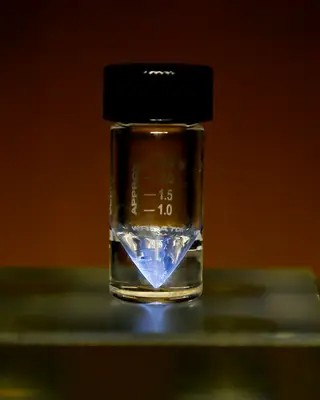
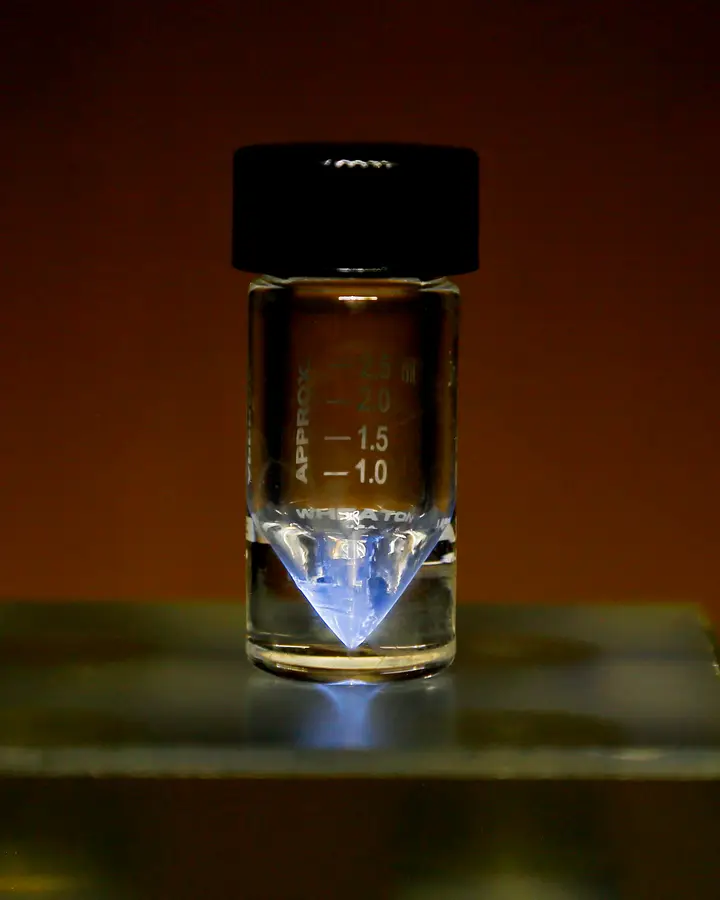
Actinium is a soft, silvery, intensely radioactive metal. Its radiation makes the air around it glow pale blue.
It occurs in tiny amounts in uranium ores; useful quantities are made in reactors.
Quick answers
- What is actinium?
- Actinium (Ac) is an actinide with atomic number 89. It is a solid at room temperature. The radioactive metal that gives the actinides their name. It glows blue in the dark, and one isotope is being developed to treat cancer.
- Where is actinium found?
- Actinium forms in the decay chain of uranium-235 and is found in uranium ores in very small amounts.
- What is actinium used for?
- Its main uses are neutron sources and medical research. Actinium–beryllium mixtures give off neutrons.
At a glance
| Atomic number | 89 |
|---|---|
| Symbol | Ac |
| Mass number (most stable isotope) | [227] |
| Family | Actinide |
| Group | f-block (the row below the main table) |
| Period | Period 7 |
| Block | f |
| Electron configuration | [Rn] 6d1 7s2 orbital diagram → |
| State at room temperature | Solid |
| Melting point | 1,051 °C (1,924 °F, 1,324 K) |
| Boiling point | 3,198 °C (5,788 °F, 3,471 K) |
| Density | 10.07 g/cm³ |
| Electronegativity (Pauling) | 1.1 |
| Atomic radius | 260 pm |
| First ionization energy | 5.17 eV |
| Oxidation states | +3 |
| Discovery | 1899 · André-Louis Debierne |
Discovery
In 1899 André-Louis Debierne, a colleague of the Curies, found actinium in pitchblende residues. Friedrich Oskar Giesel discovered it independently a few years later.
Where the name comes from
From the Greek aktis, ray or beam.
Where is actinium found?
Actinium forms in the decay chain of uranium-235 and is found in uranium ores in very small amounts.
Where every element is found →
What is actinium used for?
- Neutron sources. Actinium–beryllium mixtures give off neutrons.
- Medical research. Actinium-225 is being tested in targeted alpha therapy against cancer.
What every element is used for → · Where are the elements found? →
Notable isotopes
| Isotope | Half-life | Note |
|---|---|---|
| Actinium-227 | about 21.8 years | The longest-lived isotope, found in nature. |
| Actinium-225 | about 10 days | Studied for cancer therapy. |
Safety
Highly radioactive
All its isotopes are radioactive. It is handled only in specialized laboratories, in tiny amounts and under strict controls.
Did you know?
- Actinium was one of the first elements found after the discovery of radioactivity, a year after polonium and radium.
- The half-life of actinium-227 (21.8 years) is about 73 times shorter than that of radium-226 (1,600 years). Gram for gram, actinium-227 therefore undergoes about 73 times as many decays as radium-226.
Frequently asked questions
Why are they called actinides?
The series of fifteen elements from actinium to lawrencium is named after its first member.
Is actinium a metal?
Yes. Actinium is a metal, one of the actinides.
What are the properties of actinium?
Atomic number 89, symbol Ac, atomic mass [227]. It is a solid at room temperature. It melts at 1,051 °C (1,924 °F) and boils at 3,198 °C (5,788 °F). Density 10.07 g/cm³. Electronegativity 1.1 (Pauling).
Sources
- Royal Society of Chemistry: Actinium
- Encyclopaedia Britannica: Actinium
- NNDC NuDat 3 (nuclear data)
- PubChem Periodic Table (NIH)
- IUPAC/CIAAW standard atomic weights
- Royal Society of Chemistry, Periodic Table
- Wikipedia: Actinium
Last checked: 17 November 2026
Other actinides
Thorium
A weakly radioactive metal named after the Norse god Thor. It once made gas lamps glow and is studied as a possible nuclear fuel.
Protactinium
One of the rarest and most dangerous natural elements. Its name means “before actinium”, because it decays into actinium.
Uranium
The heaviest element found in large amounts in nature. Its radioactivity was the first ever discovered, and its fission powers nuclear reactors.
Neptunium
The first element heavier than uranium ever made. It is the starting material for the plutonium that powers deep-space probes.
Plutonium
A radioactive metal made in nuclear reactors. One isotope fuels reactors; another powers space probes that travel too far from the Sun for solar panels.
Americium
A synthetic radioactive element that is probably in your home: a tiny amount sits inside many smoke alarms.
Curium
A synthetic element named after Marie and Pierre Curie. Curium sources have analyzed rocks on Mars.
Berkelium
A synthetic element named after the city of Berkeley. It was used as a target to create element 117, tennessine.