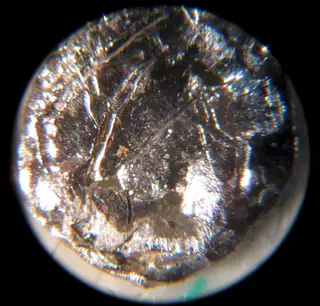
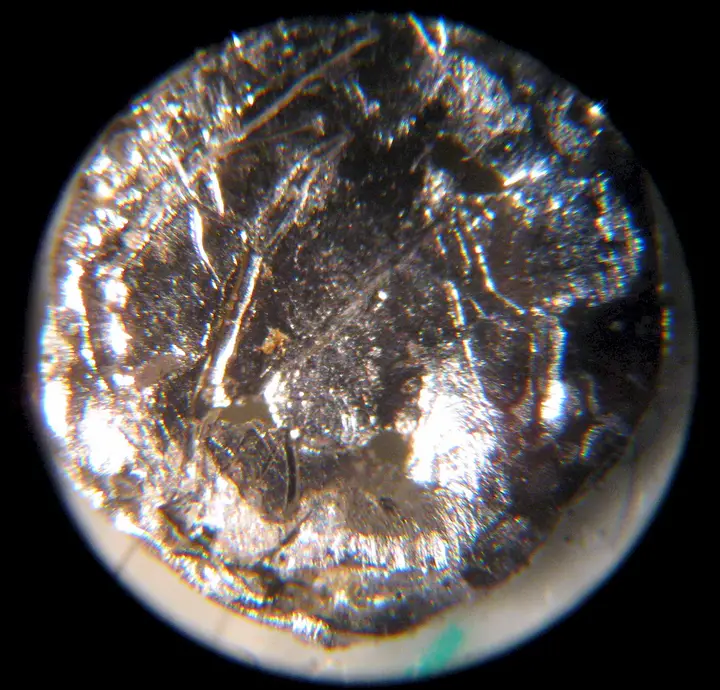
Americium is a silvery, radioactive actinide metal made in nuclear reactors.
Americium-241 gives off alpha particles that ionize air inside ionization smoke detectors. When smoke enters, the current changes and the alarm sounds.
Quick answers
- What is americium?
- Americium (Am) is an actinide with atomic number 95. It is a solid at room temperature. A synthetic radioactive element that is probably in your home: a tiny amount sits inside many smoke alarms.
- Where is americium found?
- Americium does not occur naturally in significant amounts. It is extracted from used nuclear fuel.
- What is americium used for?
- Its main uses are smoke detectors and industry. Ionization smoke alarms contain a tiny americium-241 source.
At a glance
| Atomic number | 95 |
|---|---|
| Symbol | Am |
| Mass number (most stable isotope) | [243] |
| Family | Actinide |
| Group | f-block (the row below the main table) |
| Period | Period 7 |
| Block | f |
| Electron configuration | [Rn] 5f7 7s2 orbital diagram → |
| State at room temperature | Solid |
| Melting point | 1,176 °C (2,149 °F, 1,449 K) |
| Boiling point | 2,011 °C (3,652 °F, 2,284 K) |
| Density | 13.69 g/cm³ |
| Electronegativity (Pauling) | 1.3 |
| Atomic radius | 244 pm |
| First ionization energy | 5.993 eV |
| Oxidation states | +6, +5, +4, +3 |
| Discovery | 1944 · Glenn Seaborg and team |
Discovery
In late 1944 Glenn Seaborg, Ralph James, Leon Morgan and Albert Ghiorso at the University of Chicago produced americium by bombarding plutonium with neutrons.
Where the name comes from
Named after the Americas, by analogy with europium, the lanthanide just above it in the table, which is named after Europe.
Where is americium found?
Americium does not occur naturally in significant amounts. It is extracted from used nuclear fuel.
Where every element is found →
What is americium used for?
- Smoke detectors. Ionization smoke alarms contain a tiny americium-241 source.
- Industry. Americium–beryllium neutron sources are used to measure soil moisture and in oil-well logging.
What every element is used for → · Where are the elements found? →
Common compounds
| Compound | Formula | Note |
|---|---|---|
| Americium dioxide | AmO₂ | The chemical form of the tiny source in smoke detectors. |
Notable isotopes
| Isotope | Half-life | Note |
|---|---|---|
| Americium-241 | about 432 years | Used in smoke detectors. |
| Americium-243 | about 7,400 years | The longest-lived isotope. |
Safety
Radioactive; safe in a sealed detector
The americium in a smoke detector is sealed and poses no risk in normal use. Do not take detectors apart; dispose of them as local rules advise.
Did you know?
- Glenn Seaborg revealed the discovery of americium and curium in November 1945 on a children’s radio program, Quiz Kids, answering a listener’s question, just before the official announcement.
- The americium in a smoke detector weighs well under a millionth of a gram.
- Americium is one of very few synthetic elements found in ordinary homes.
Frequently asked questions
Is my smoke detector radioactive?
Ionization smoke detectors contain a very small sealed americium source; the radiation outside the detector is negligible.
Why is it called americium?
It sits below europium in the periodic table, so it was named after the Americas.
Is americium a metal?
Yes. Americium is a metal, one of the actinides.
What are the properties of americium?
Atomic number 95, symbol Am, atomic mass [243]. It is a solid at room temperature. It melts at 1,176 °C (2,149 °F) and boils at 2,011 °C (3,652 °F). Density 13.69 g/cm³. Electronegativity 1.3 (Pauling).
Read more on OkButWhy
Sources
- Royal Society of Chemistry: Americium
- Encyclopaedia Britannica: Americium
- NNDC NuDat 3 (nuclear data)
- PubChem Periodic Table (NIH)
- IUPAC/CIAAW standard atomic weights
- Royal Society of Chemistry, Periodic Table
- Wikipedia: Americium
Last checked: 16 November 2026
Other actinides
Actinium
The radioactive metal that gives the actinides their name. It glows blue in the dark, and one isotope is being developed to treat cancer.
Thorium
A weakly radioactive metal named after the Norse god Thor. It once made gas lamps glow and is studied as a possible nuclear fuel.
Protactinium
One of the rarest and most dangerous natural elements. Its name means “before actinium”, because it decays into actinium.
Uranium
The heaviest element found in large amounts in nature. Its radioactivity was the first ever discovered, and its fission powers nuclear reactors.
Neptunium
The first element heavier than uranium ever made. It is the starting material for the plutonium that powers deep-space probes.
Plutonium
A radioactive metal made in nuclear reactors. One isotope fuels reactors; another powers space probes that travel too far from the Sun for solar panels.
Curium
A synthetic element named after Marie and Pierre Curie. Curium sources have analyzed rocks on Mars.
Berkelium
A synthetic element named after the city of Berkeley. It was used as a target to create element 117, tennessine.