Element 047
Silver (Ag)
The best conductor of electricity and the most reflective metal. Silver has been money and jewelry for millennia and now goes into solar panels and electronics.
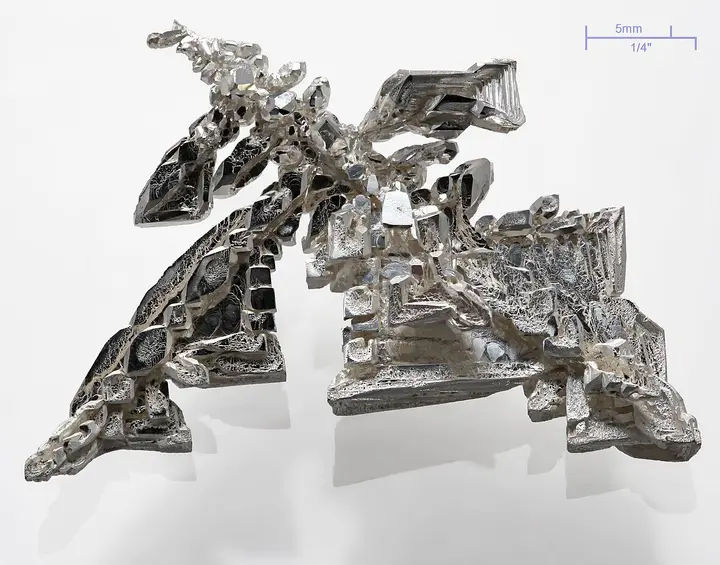
Silver is a soft, brilliant white precious metal. Of all metals it conducts electricity and heat best and reflects the most visible light.
It does not react with oxygen in air, but traces of sulfur compounds slowly tarnish it black.
Quick answers
- What is silver?
- Silver (Ag) is a transition metal with atomic number 47. It is a solid at room temperature. The best conductor of electricity and the most reflective metal. Silver has been money and jewelry for millennia and now goes into solar panels and electronics.
- Where is silver found?
- Silver is sometimes found as native metal, but most comes as a by-product of mining lead, zinc, copper and gold. Mexico and Peru are major producers.
- What is silver used for?
- Its main uses are electronics and solar; jewelry and silverware; coins and investment. Silver pastes and contacts are used in solar cells, circuit boards and switches.
At a glance
| Atomic number | 47 |
|---|---|
| Symbol | Ag |
| Standard atomic weight | 107.87 ± 0.01 |
| Natural isotopes | 2 (IUPAC CIAAW 2024) |
| Family | Transition metal |
| Group | Group 11 |
| Period | Period 5 |
| Block | d |
| Electron configuration | [Kr] 4d10 5s1 orbital diagram → |
| State at room temperature | Solid |
| Melting point | 961.78 °C (1,763.2 °F, 1,234.93 K) |
| Boiling point | 2,162 °C (3,923 °F, 2,435 K) |
| Density | 10.501 g/cm³ |
| Electronegativity (Pauling) | 1.93 |
| Atomic radius | 172 pm |
| First ionization energy | 7.576 eV |
| Oxidation states | +1 |
| Discovery | Known since ancient times |
Discovery
Silver has been mined for at least 5,000 years. In ancient times it was often worth more than gold.
Where the name comes from
The English word comes from Old English seolfor. The symbol Ag comes from the Latin argentum, from a root meaning shining or white; Argentina is named after it.
Where is silver found?
Silver is sometimes found as native metal, but most comes as a by-product of mining lead, zinc, copper and gold. Mexico and Peru are major producers.
Where every element is found →
What is silver used for?
- Electronics and solar. Silver pastes and contacts are used in solar cells, circuit boards and switches.
- Jewelry and silverware. Sterling silver is 92.5% silver alloyed with copper for strength.
- Coins and investment. Silver bullion and coins are held as stores of value.
- Mirrors and medicine. Silver coats high-quality mirrors, and silver compounds are used in some wound dressings.
What every element is used for → · Where are the elements found? →
Common compounds
| Compound | Formula | Note |
|---|---|---|
| Silver nitrate | AgNO₃ | A corrosive silver salt. |
| Silver iodide | AgI | Used in cloud seeding. |
| Silver sulfide | Ag₂S | The black tarnish that forms on silverware. |
Notable isotopes
- Ag-10751.839%
- Ag-10948.161%
Percent by number of atoms. The light band shows the range over which the share varies in natural samples. Source: IUPAC CIAAW 2024
| Isotope | Half-life | Note |
|---|---|---|
| Silver-107 | Stable | About 51.8% of natural silver. |
| Silver-109 | Stable | About 48.2%. |
Safety
Metal is safe; long-term ingestion is not
Silver jewelry and cutlery are safe.
Swallowing silver compounds or colloidal silver over long periods can cause argyria, a permanent blue-gray discoloration of the skin.
Did you know?
- Silver is tarnished by tiny amounts of sulfur compounds in air, not by oxygen. Eggs, which contain sulfur, can blacken a silver spoon quickly.
- Spraying silver iodide into clouds to encourage rain or snow is called cloud seeding.
- The silver mines of Laurion near Athens paid for the Athenian navy in the 5th century BCE.
Frequently asked questions
Why does silver tarnish?
It reacts with sulfur compounds in air, such as hydrogen sulfide, forming a thin black layer of silver sulfide.
What is sterling silver?
An alloy of 92.5% silver and 7.5% other metals, usually copper, which makes it harder than pure silver.
Is silver a metal?
Yes. Silver is a metal, one of the transition metals.
What are the properties of silver?
Atomic number 47, symbol Ag, atomic mass 107.87. It is a solid at room temperature. It melts at 961.78 °C (1,763.2 °F) and boils at 2,162 °C (3,923 °F). Density 10.501 g/cm³. Electronegativity 1.93 (Pauling).
Sources
- Royal Society of Chemistry: Silver
- Encyclopaedia Britannica: Silver
- USGS Mineral Commodity Summaries: Silver
- NNDC NuDat 3 (nuclear data)
- PubChem Periodic Table (NIH)
- IUPAC/CIAAW standard atomic weights
- Royal Society of Chemistry, Periodic Table
- Wikipedia: Silver
Last checked: 16 November 2026
Other group 11 elements
Copper
One of the first metals people used and still the metal of electrical wiring. Bronze and brass are copper alloys.
Gold
The yellow metal that never tarnishes. Gold has been money, jewelry and a symbol of value for thousands of years, and it is also used in electronics and spacecraft.
Roentgenium
A superheavy element named after Wilhelm Röntgen, discoverer of X-rays. It sits below gold in the table.