Element 046
Palladium (Pd)
A precious metal that soaks up hydrogen like a sponge. Most of it cleans exhaust gases in petrol cars.
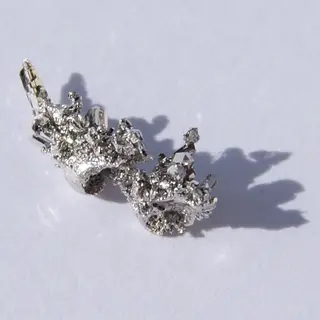
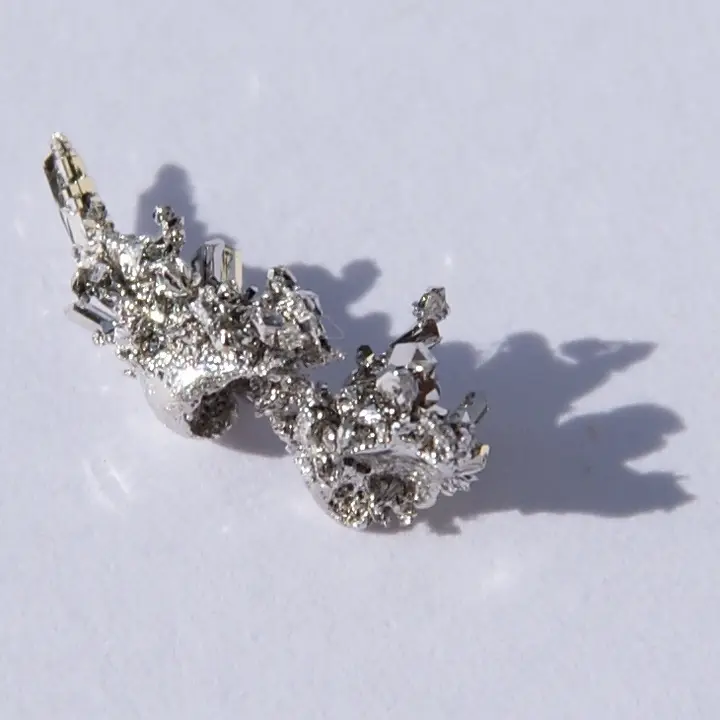
Palladium is a soft, silvery-white precious metal in the platinum group. It does not tarnish in air.
At room temperature it can absorb hundreds of times its own volume of hydrogen, and it is an excellent catalyst.
Quick answers
- What is palladium?
- Palladium (Pd) is a transition metal with atomic number 46. It is a solid at room temperature. A precious metal that soaks up hydrogen like a sponge. Most of it cleans exhaust gases in petrol cars.
- Where is palladium found?
- Palladium is mined with platinum and nickel; Russia and South Africa produce most of it.
- What is palladium used for?
- Its main uses are catalytic converters, electronics and chemistry. The largest use, especially in petrol-engine cars.
At a glance
| Atomic number | 46 |
|---|---|
| Symbol | Pd |
| Standard atomic weight | 106.42 ± 0.01 |
| Natural isotopes | 6 (IUPAC CIAAW 2024) |
| Family | Transition metal |
| Group | Group 10 |
| Period | Period 5 |
| Block | d |
| Electron configuration | [Kr] 4d10 orbital diagram → |
| State at room temperature | Solid |
| Melting point | 1,554.90 °C (2,830.8 °F, 1,828.05 K) |
| Boiling point | 2,963 °C (5,365 °F, 3,236 K) |
| Density | 12 g/cm³ |
| Electronegativity (Pauling) | 2.2 |
| Atomic radius | 202 pm |
| First ionization energy | 8.337 eV |
| Oxidation states | +3, +2 |
| Discovery | 1803 · William Hyde Wollaston |
Discovery
In 1803 the English chemist William Hyde Wollaston separated palladium from platinum ore. He first offered it for sale anonymously through a London shop before revealing he had discovered it.
Where the name comes from
Named after the asteroid Pallas, discovered a year earlier. Pallas is a title of the goddess Athena.
Where is palladium found?
Palladium is mined with platinum and nickel; Russia and South Africa produce most of it.
Where every element is found →
What is palladium used for?
- Catalytic converters. The largest use, especially in petrol-engine cars.
- Electronics. Palladium is used in capacitors and connectors.
- Chemistry. Palladium catalysts help build complex molecules for medicines and materials.
- Jewelry and dentistry. White gold alloys and dental alloys.
What every element is used for → · Where are the elements found? →
Notable isotopes
- Pd-1021.02%
- Pd-10411.14%
- Pd-10522.33%
- Pd-10627.33%
- Pd-10826.46%
- Pd-11011.72%
Percent by number of atoms. The light band shows the range over which the share varies in natural samples. Source: IUPAC CIAAW 2024
| Isotope | Half-life | Note |
|---|---|---|
| Palladium-106 | Stable | About 27.3% of natural palladium. |
| Palladium-108 | Stable | About 26.5%. |
| Palladium-105 | Stable | About 22.3%. |
Safety
Low hazard
Palladium metal is not toxic in normal use, though some people are allergic to it.
Did you know?
- Palladium membranes let only hydrogen through, so they are used to make very pure hydrogen.
- The controversial 1989 “cold fusion” experiments used palladium electrodes; the results could not be reproduced.
- The 2010 Nobel Prize in Chemistry recognized palladium-catalyzed reactions that join carbon atoms.
Frequently asked questions
Is palladium more valuable than gold?
Its price changes with demand from car makers; at times it has been worth more than gold.
Why does palladium absorb hydrogen?
Hydrogen atoms fit into spaces in palladium’s crystal structure.
Is palladium a metal?
Yes. Palladium is a metal, one of the transition metals.
What are the properties of palladium?
Atomic number 46, symbol Pd, atomic mass 106.42. It is a solid at room temperature. It melts at 1,554.90 °C (2,830.8 °F) and boils at 2,963 °C (5,365 °F). Density 12 g/cm³. Electronegativity 2.2 (Pauling).
Sources
- Royal Society of Chemistry: Palladium
- Encyclopaedia Britannica: Palladium
- Nobel Prize in Chemistry 2010 (palladium-catalysed cross couplings)
- NNDC NuDat 3 (nuclear data)
- PubChem Periodic Table (NIH)
- IUPAC/CIAAW standard atomic weights
- Royal Society of Chemistry, Periodic Table
- Wikipedia: Palladium
Last checked: 16 November 2026
Other group 10 elements
Nickel
A tough, silvery metal that keeps stainless steel from rusting. It is in coins, rechargeable batteries and jet engines.
Platinum
A rare, heavy, silvery-white precious metal. Platinum cleans car exhaust in catalytic converters and is prized in jewelry.
Darmstadtium
A superheavy element named after the German city of Darmstadt, where six elements were discovered.