Element 045
Rhodium (Rh)
One of the rarest and, at times, the most expensive precious metal. It cleans car exhaust and gives jewelry a brilliant white finish.
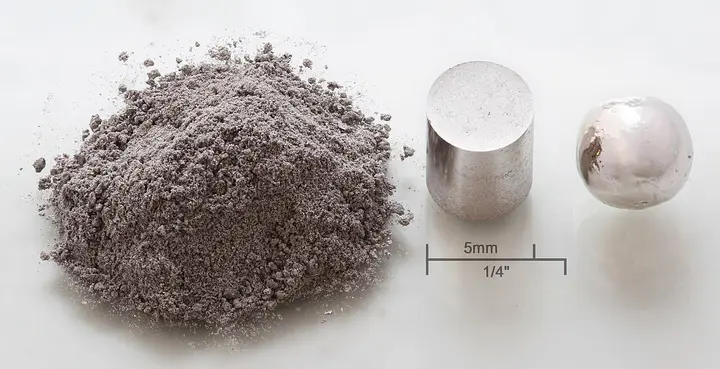
Rhodium is a hard, silvery-white platinum-group metal. It is highly reflective and resists corrosion.
Most rhodium is used in catalytic converters, where it is especially good at breaking down nitrogen oxides.
Quick answers
- What is rhodium?
- Rhodium (Rh) is a transition metal with atomic number 45. It is a solid at room temperature. One of the rarest and, at times, the most expensive precious metal. It cleans car exhaust and gives jewelry a brilliant white finish.
- Where is rhodium found?
- Rhodium is mined with platinum, mainly in South Africa. Only a few tens of metric tons are produced each year.
- What is rhodium used for?
- Its main uses are catalytic converters, jewelry plating and industry. Rhodium turns nitrogen oxides from car exhaust into nitrogen.
At a glance
| Atomic number | 45 |
|---|---|
| Symbol | Rh |
| Standard atomic weight | 102.91 ± 0.01 |
| Natural isotopes | 1 (IUPAC CIAAW 2024; a single isotope in nature) |
| Family | Transition metal |
| Group | Group 9 |
| Period | Period 5 |
| Block | d |
| Electron configuration | [Kr] 4d8 5s1 orbital diagram → |
| State at room temperature | Solid |
| Melting point | 1,964 °C (3,567 °F, 2,237 K) |
| Boiling point | 3,695 °C (6,683 °F, 3,968 K) |
| Density | 12.4 g/cm³ |
| Electronegativity (Pauling) | 2.28 |
| Atomic radius | 195 pm |
| First ionization energy | 7.459 eV |
| Oxidation states | +3 |
| Discovery | 1803 · William Hyde Wollaston |
Discovery
In 1803–1804 William Hyde Wollaston isolated rhodium from platinum ore, shortly after he discovered palladium.
Where the name comes from
From the Greek rhodon, rose, after the rose-pink color of its salts.
Where is rhodium found?
Rhodium is mined with platinum, mainly in South Africa. Only a few tens of metric tons are produced each year.
Where every element is found →
What is rhodium used for?
- Catalytic converters. Rhodium turns nitrogen oxides from car exhaust into nitrogen.
- Jewelry plating. White gold is often plated with rhodium for a bright, durable finish.
- Industry. Glass fiber production, thermocouples and chemical catalysts.
What every element is used for → · Where are the elements found? →
Notable isotopes
| Isotope | Half-life | Note |
|---|---|---|
| Rhodium-103 | Stable | The only stable isotope; all natural rhodium. |
Safety
Low hazard
Rhodium metal is inert. Some rhodium compounds are toxic.
Did you know?
- Rhodium’s price swings wildly because supply is so small; at times it has cost several times as much as gold.
- In 1979 Guinness World Records gave Paul McCartney a rhodium-plated disc for being the best-selling musician.
- All natural rhodium is a single isotope, rhodium-103.
Frequently asked questions
Why is rhodium so expensive?
It is extremely rare and mostly produced as a by-product of platinum mining, while demand from car makers is high.
Is white gold plated with rhodium?
Often, yes. Rhodium plating makes white gold look whiter and resist scratches.
Is rhodium a metal?
Yes. Rhodium is a metal, one of the transition metals.
What are the properties of rhodium?
Atomic number 45, symbol Rh, atomic mass 102.91. It is a solid at room temperature. It melts at 1,964 °C (3,567 °F) and boils at 3,695 °C (6,683 °F). Density 12.4 g/cm³. Electronegativity 2.28 (Pauling).
Sources
- Royal Society of Chemistry: Rhodium
- Encyclopaedia Britannica: Rhodium
- USGS Mineral Commodity Summaries: Platinum-group metals
- NNDC NuDat 3 (nuclear data)
- PubChem Periodic Table (NIH)
- IUPAC/CIAAW standard atomic weights
- Royal Society of Chemistry, Periodic Table
- Wikipedia: Rhodium
Last checked: 16 November 2026
Other group 9 elements
Cobalt
The metal behind deep cobalt-blue glass and many rechargeable batteries. It is also at the center of vitamin B12.
Iridium
One of the densest and most corrosion-resistant metals. A thin layer of iridium in rocks helped explain the extinction of the dinosaurs.
Meitnerium
A superheavy element named after Lise Meitner, who helped explain nuclear fission.