Element 044
Ruthenium (Ru)
A hard, rare platinum-group metal used in hard drives, electronics and Nobel Prize-winning catalysts.
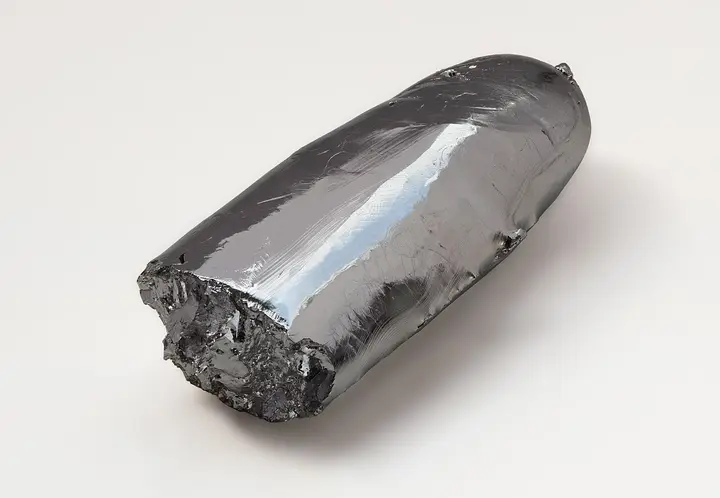
Ruthenium is a hard, silvery-white metal of the platinum group. It does not tarnish at room temperature.
It is mostly used in very thin layers and as a catalyst, so small amounts go a long way.
Quick answers
- What is ruthenium?
- Ruthenium (Ru) is a transition metal with atomic number 44. It is a solid at room temperature. A hard, rare platinum-group metal used in hard drives, electronics and Nobel Prize-winning catalysts.
- Where is ruthenium found?
- Ruthenium is mined with platinum and nickel, mainly in South Africa and Russia.
- What is ruthenium used for?
- Its main uses are electronics, catalysts and alloys. Thin ruthenium layers in hard disk drives, chip resistors and electrical contacts.
At a glance
| Atomic number | 44 |
|---|---|
| Symbol | Ru |
| Standard atomic weight | 101.07 ± 0.02 |
| Natural isotopes | 7 (IUPAC CIAAW 2024) |
| Family | Transition metal |
| Group | Group 8 |
| Period | Period 5 |
| Block | d |
| Electron configuration | [Kr] 4d7 5s1 orbital diagram → |
| State at room temperature | Solid |
| Melting point | 2,334 °C (4,233 °F, 2,607 K) |
| Boiling point | 4,150 °C (7,502 °F, 4,423 K) |
| Density | 12.1 g/cm³ |
| Electronegativity (Pauling) | 2.2 |
| Atomic radius | 207 pm |
| First ionization energy | 7.361 eV |
| Oxidation states | +3 |
| Discovery | 1844 · Karl Ernst Claus |
Discovery
In 1844 Karl Ernst Claus at Kazan University in Russia isolated ruthenium from residues of platinum ore from the Ural Mountains.
Where the name comes from
From Ruthenia, a Latin name for Russia.
Where is ruthenium found?
Ruthenium is mined with platinum and nickel, mainly in South Africa and Russia.
Where every element is found →
What is ruthenium used for?
- Electronics. Thin ruthenium layers in hard disk drives, chip resistors and electrical contacts.
- Catalysts. Ruthenium catalysts are used to make ammonia and in organic chemistry.
- Alloys. Small amounts harden platinum and palladium.
What every element is used for → · Where are the elements found? →
Notable isotopes
- Ru-965.54%
- Ru-981.87%
- Ru-9912.76%
- Ru-10012.6%
- Ru-10117.06%
- Ru-10231.55%
- Ru-10418.62%
Percent by number of atoms. The light band shows the range over which the share varies in natural samples. Source: IUPAC CIAAW 2024
| Isotope | Half-life | Note |
|---|---|---|
| Ruthenium-102 | Stable | The most common isotope, about 32%. |
| Ruthenium-106 | about 1 year | A fission product. |
Safety
Its oxide is toxic
Ruthenium metal is inert, but ruthenium tetroxide is volatile and toxic.
Did you know?
- Ruthenium was the first element named after Russia.
- In autumn 2017, very low levels of ruthenium-106 were measured in the air across Europe. The source was traced to the southern Urals; the levels were not a health risk in Europe.
- Part of the 2005 Nobel Prize in Chemistry recognized ruthenium catalysts for metathesis reactions.
Frequently asked questions
Is ruthenium a precious metal?
Yes. It is one of the six platinum-group metals.
What is ruthenium used for?
Mainly electronics and catalysts.
Is ruthenium a metal?
Yes. Ruthenium is a metal, one of the transition metals.
What are the properties of ruthenium?
Atomic number 44, symbol Ru, atomic mass 101.07. It is a solid at room temperature. It melts at 2,334 °C (4,233 °F) and boils at 4,150 °C (7,502 °F). Density 12.1 g/cm³. Electronegativity 2.2 (Pauling).
Sources
- Royal Society of Chemistry: Ruthenium
- Encyclopaedia Britannica: Ruthenium
- Nobel Prize in Chemistry 2005 (metathesis)
- Masson et al. (2019), PNAS: Airborne ruthenium-106 in Europe, 2017
- NNDC NuDat 3 (nuclear data)
- PubChem Periodic Table (NIH)
- IUPAC/CIAAW standard atomic weights
- Royal Society of Chemistry, Periodic Table
- Wikipedia: Ruthenium
Last checked: 16 November 2026
Other group 8 elements
Iron
The main ingredient of Earth’s core and the most used metal. Steel, bridges and machines are made of iron; it also makes blood red.
Osmium
The densest naturally occurring element, narrowly ahead of iridium. A football-sized ball of osmium would weigh about as much as two adults.
Hassium
A superheavy element named after the German state of Hesse. One of the few superheavy elements whose chemistry has been studied.