Element 027
Cobalt (Co)
The metal behind deep cobalt-blue glass and many rechargeable batteries. It is also at the center of vitamin B12.
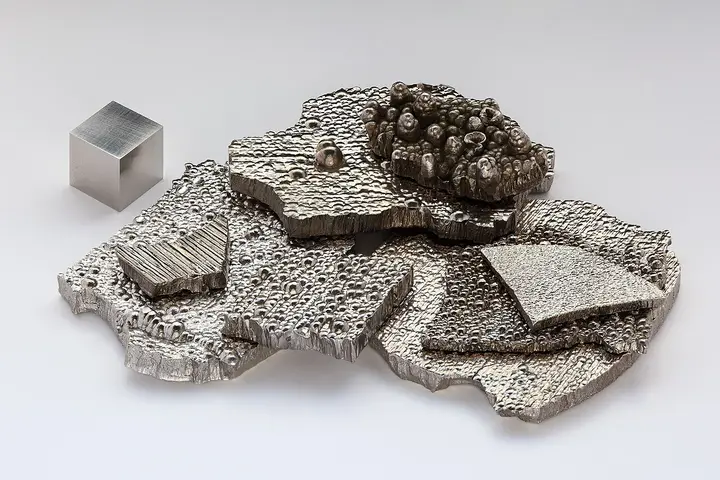
Cobalt is a hard, lustrous, bluish-gray metal. Like iron and nickel it is magnetic, and it keeps its magnetism at higher temperatures than any other element.
Its compounds have colored glass and ceramics a deep blue for thousands of years. Today most cobalt goes into batteries and high-temperature alloys.
Quick answers
- What is cobalt?
- Cobalt (Co) is a transition metal with atomic number 27. It is a solid at room temperature. The metal behind deep cobalt-blue glass and many rechargeable batteries. It is also at the center of vitamin B12.
- Where is cobalt found?
- Cobalt is usually mined as a by-product of copper and nickel. The Democratic Republic of the Congo produces most of the world’s supply.
- What is cobalt used for?
- Its main uses are batteries; superalloys; magnets and tools. Many lithium-ion battery cathodes contain cobalt.
At a glance
| Atomic number | 27 |
|---|---|
| Symbol | Co |
| Standard atomic weight | 58.933 ± 0.001 |
| Natural isotopes | 1 (IUPAC CIAAW 2024; a single isotope in nature) |
| Family | Transition metal |
| Group | Group 9 |
| Period | Period 4 |
| Block | d |
| Electron configuration | [Ar] 3d7 4s2 orbital diagram → |
| State at room temperature | Solid |
| Melting point | 1,495 °C (2,723 °F, 1,768 K) |
| Boiling point | 2,927 °C (5,300 °F, 3,200 K) |
| Density | 8.86 g/cm³ |
| Electronegativity (Pauling) | 1.88 |
| Atomic radius | 192 pm |
| First ionization energy | 7.881 eV |
| Oxidation states | +3, +2 |
| Discovery | 1735 · Georg Brandt |
Discovery
Around 1735 the Swedish chemist Georg Brandt showed that the blue color of certain glasses came from a new metal, not from bismuth as people had thought. Cobalt is often said to be the first metal discovered since ancient times.
Where the name comes from
From the German Kobold, a goblin. Miners blamed goblins for ores that looked valuable but released poisonous fumes (from arsenic) and yielded no useful metal.
Where is cobalt found?
Cobalt is usually mined as a by-product of copper and nickel. The Democratic Republic of the Congo produces most of the world’s supply.
Where every element is found →
What is cobalt used for?
- Batteries. Many lithium-ion battery cathodes contain cobalt.
- Superalloys. Cobalt alloys stay strong in jet engines and gas turbines.
- Magnets and tools. Samarium–cobalt and AlNiCo magnets; cobalt also binds tungsten carbide cutting tools.
- Color and medicine. Cobalt blue pigment; cobalt-60 is used in radiotherapy and to sterilize medical equipment.
What every element is used for → · Where are the elements found? →
Common compounds
| Compound | Formula | Note |
|---|---|---|
| Cobalt aluminate | CoAl₂O₄ | The pigment cobalt blue. |
| Lithium cobalt oxide | LiCoO₂ | Cathode material of many lithium-ion batteries. |
Notable isotopes
| Isotope | Half-life | Note |
|---|---|---|
| Cobalt-59 | Stable | The only stable isotope; all natural cobalt. |
| Cobalt-60 | about 5.27 years | Radioactive, made in reactors. Used for radiotherapy, sterilization and industrial radiography. |
Safety
Dust and radioactive sources
Cobalt is part of vitamin B12, but cobalt dust and some compounds are harmful if inhaled.
Lost or abandoned cobalt-60 sources have caused serious radiation accidents; such sources must be secured and disposed of properly.
Did you know?
- Cobalt loses its magnetism (its Curie temperature) at about 1,115 °C, the highest of any element.
- A cobalt atom sits at the center of vitamin B12.
- All natural cobalt is a single isotope, cobalt-59.
Frequently asked questions
Why is cobalt used in batteries?
Cobalt helps lithium-ion cathodes store a lot of energy and stay stable over many charge cycles.
Is cobalt blue made from cobalt?
Yes. Cobalt blue is cobalt aluminate, a stable blue pigment.
Is cobalt a metal?
Yes. Cobalt is a metal, one of the transition metals.
What are the properties of cobalt?
Atomic number 27, symbol Co, atomic mass 58.933. It is a solid at room temperature. It melts at 1,495 °C (2,723 °F) and boils at 2,927 °C (5,300 °F). Density 8.86 g/cm³. Electronegativity 1.88 (Pauling).
Read more on OkButWhy
Sources
- Royal Society of Chemistry: Cobalt
- Encyclopaedia Britannica: Cobalt
- USGS Mineral Commodity Summaries: Cobalt
- NNDC NuDat 3 (nuclear data)
- PubChem Periodic Table (NIH)
- IUPAC/CIAAW standard atomic weights
- Royal Society of Chemistry, Periodic Table
- Wikipedia: Cobalt
Last checked: 16 November 2026
Other group 9 elements
Rhodium
One of the rarest and, at times, the most expensive precious metal. It cleans car exhaust and gives jewelry a brilliant white finish.
Iridium
One of the densest and most corrosion-resistant metals. A thin layer of iridium in rocks helped explain the extinction of the dinosaurs.
Meitnerium
A superheavy element named after Lise Meitner, who helped explain nuclear fission.