Element 066
Dysprosium (Dy)
The “hard to get” rare earth. Electric-car motors and wind turbines need it to keep their magnets strong when hot.
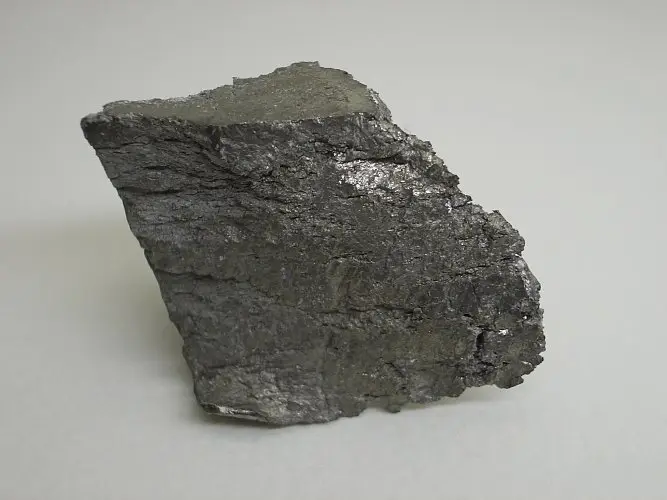
Dysprosium is a bright, silvery metal. It is one of the lanthanides, the row of fifteen “rare earth” metals that are so chemically alike that separating them took chemists most of the 19th century.
Quick answers
- What is dysprosium?
- Dysprosium (Dy) is a lanthanide with atomic number 66. It is a solid at room temperature. The “hard to get” rare earth. Electric-car motors and wind turbines need it to keep their magnets strong when hot.
- Where is dysprosium found?
- Dysprosium comes mainly from ion-adsorption clays in southern China and Southeast Asia.
- What is dysprosium used for?
- Its main uses are magnets, terfenol-D and nuclear reactors. Added to neodymium magnets so they keep their strength at high temperatures.
At a glance
| Atomic number | 66 |
|---|---|
| Symbol | Dy |
| Standard atomic weight | 162.50 ± 0.01 |
| Natural isotopes | 7 (IUPAC CIAAW 2024) |
| Family | Lanthanide |
| Group | f-block (the row below the main table) |
| Period | Period 6 |
| Block | f |
| Electron configuration | [Xe] 4f10 6s2 orbital diagram → |
| State at room temperature | Solid |
| Melting point | 1,412 °C (2,573 °F, 1,685 K) |
| Boiling point | 2,567 °C (4,652 °F, 2,840 K) |
| Density | 8.55 g/cm³ |
| Electronegativity (Pauling) | 1.22 |
| Atomic radius | 229 pm |
| First ionization energy | 5.939 eV |
| Oxidation states | +3 |
| Discovery | 1886 · Paul-Émile Lecoq de Boisbaudran |
Discovery
In 1886 Paul-Émile Lecoq de Boisbaudran separated dysprosium oxide from holmium oxide after many painstaking attempts.
Where the name comes from
From the Greek dysprositos, hard to get at, because it was so difficult to separate.
Where is dysprosium found?
Dysprosium comes mainly from ion-adsorption clays in southern China and Southeast Asia.
Where every element is found →
What is dysprosium used for?
- Magnets. Added to neodymium magnets so they keep their strength at high temperatures.
- Terfenol-D. Magnetostrictive alloys for sonar and precision actuators.
- Nuclear reactors. Dysprosium absorbs neutrons.
What every element is used for → · Where are the elements found? →
Notable isotopes
- Dy-1560.056%
- Dy-1580.095%
- Dy-1602.329%
- Dy-16118.889%
- Dy-16225.475%
- Dy-16324.896%
- Dy-16428.26%
Percent by number of atoms. The light band shows the range over which the share varies in natural samples. Source: IUPAC CIAAW 2024
| Isotope | Half-life | Note |
|---|---|---|
| Dysprosium-164 | Stable | The most common isotope, about 28%. |
Safety
Low hazard
Dysprosium has low toxicity; the powder can ignite.
Did you know?
- Dysprosium often appears on lists of critical raw materials: production depends on a few countries and recycling is difficult.
Frequently asked questions
Why do electric cars need dysprosium?
Their motors run hot, and dysprosium stops the neodymium magnets inside from losing strength.
Is dysprosium a metal?
Yes. Dysprosium is a metal, one of the lanthanides.
What are the properties of dysprosium?
Atomic number 66, symbol Dy, atomic mass 162.50. It is a solid at room temperature. It melts at 1,412 °C (2,573 °F) and boils at 2,567 °C (4,652 °F). Density 8.55 g/cm³. Electronegativity 1.22 (Pauling).
Sources
- Royal Society of Chemistry: Dysprosium
- Encyclopaedia Britannica: Dysprosium
- USGS Mineral Commodity Summaries: Rare earths
- NNDC NuDat 3 (nuclear data)
- PubChem Periodic Table (NIH)
- IUPAC/CIAAW standard atomic weights
- Royal Society of Chemistry, Periodic Table
- Wikipedia: Dysprosium
Last checked: 16 November 2026
Other lanthanides
Lanthanum
The metal that gives the lanthanides their name. It is in hybrid-car batteries, camera lenses and the catalysts that refine petrol.
Cerium
The most abundant rare earth element. It polishes glass, cleans car exhaust and makes the sparks in lighters.
Praseodymium
The “green twin” of neodymium. It strengthens magnets, colors glass and ceramics, and protects glassblowers’ eyes.
Neodymium
The rare earth metal behind the strongest permanent magnets, used in electric cars, wind turbines, headphones and phones.
Promethium
The only radioactive lanthanide, with no stable isotopes. It was finally identified among the fission products of a nuclear reactor.
Samarium
The first element named, indirectly, after a person. Samarium–cobalt magnets work at temperatures that defeat other strong magnets.
Europium
The most reactive lanthanide, named after Europe. Its glowing compounds make the reds and blues of screens and LEDs.
Gadolinium
A lanthanide used to sharpen MRI scans. It absorbs neutrons better than any other element and is magnetic around room temperature.