Element 062
Samarium (Sm)
The first element named, indirectly, after a person. Samarium–cobalt magnets work at temperatures that defeat other strong magnets.
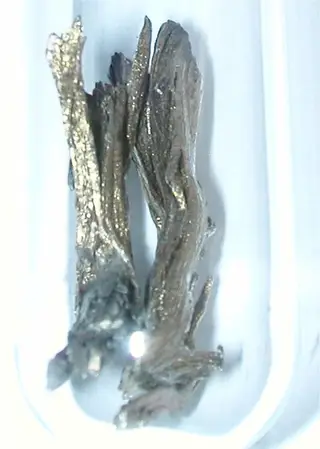
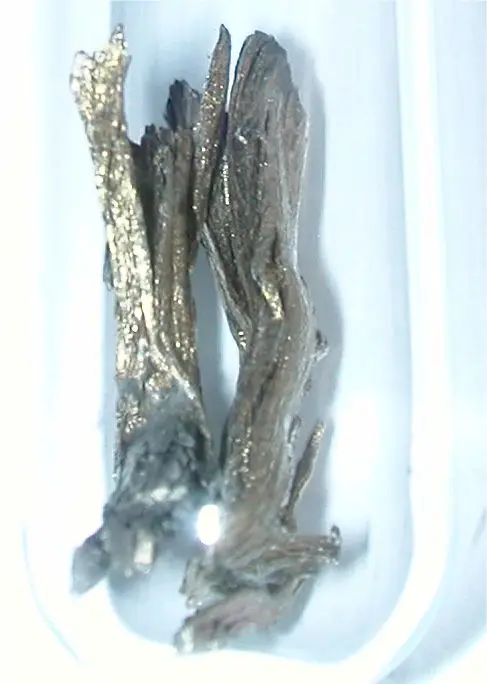
Samarium is a silvery metal that tarnishes slowly in air. It is one of the lanthanides, the row of fifteen “rare earth” metals that are so chemically alike that separating them took chemists most of the 19th century.
Quick answers
- What is samarium?
- Samarium (Sm) is a lanthanide with atomic number 62. It is a solid at room temperature. The first element named, indirectly, after a person. Samarium–cobalt magnets work at temperatures that defeat other strong magnets.
- Where is samarium found?
- Samarium is found in monazite and bastnäsite.
- What is samarium used for?
- Its main uses are magnets, nuclear reactors and medicine. Samarium–cobalt magnets keep their strength at high temperatures, in aerospace and precision motors.
At a glance
| Atomic number | 62 |
|---|---|
| Symbol | Sm |
| Standard atomic weight | 150.36 ± 0.02 |
| Natural isotopes | 7 (IUPAC CIAAW 2024) |
| Family | Lanthanide |
| Group | f-block (the row below the main table) |
| Period | Period 6 |
| Block | f |
| Electron configuration | [Xe] 4f6 6s2 orbital diagram → |
| State at room temperature | Solid |
| Melting point | 1,074 °C (1,965 °F, 1,347 K) |
| Boiling point | 1,794 °C (3,261 °F, 2,067 K) |
| Density | 7.52 g/cm³ |
| Electronegativity (Pauling) | 1.17 |
| Atomic radius | 229 pm |
| First ionization energy | 5.644 eV |
| Oxidation states | +3, +2 |
| Discovery | 1879 · Paul-Émile Lecoq de Boisbaudran |
Discovery
In 1879 Paul-Émile Lecoq de Boisbaudran found samarium spectroscopically in the mineral samarskite.
Where the name comes from
From the mineral samarskite, named after the Russian mining engineer Vasili Samarsky-Bykhovets. It was the first element named, indirectly, after a person.
Where is samarium found?
Samarium is found in monazite and bastnäsite.
Where every element is found →
What is samarium used for?
- Magnets. Samarium–cobalt magnets keep their strength at high temperatures, in aerospace and precision motors.
- Nuclear reactors. Samarium absorbs neutrons.
- Medicine. Samarium-153 relieves bone pain in some cancers.
What every element is used for → · Where are the elements found? →
Notable isotopes
- Sm-1443.08%
- Sm-14715%
- Sm-14811.25%
- Sm-14913.82%
- Sm-1507.37%
- Sm-15226.74%
- Sm-15422.74%
Percent by number of atoms. The light band shows the range over which the share varies in natural samples. Source: IUPAC CIAAW 2024
| Isotope | Half-life | Note |
|---|---|---|
| Samarium-152 | Stable | The most common isotope, about 27%. |
| Samarium-147 | about 106 billion years | Used to date rocks and meteorites. |
Safety
Low hazard
Samarium has low toxicity; the powder can ignite.
Did you know?
- Samarium–cobalt magnets, developed in the 1960s, were the strongest permanent magnets known until neodymium magnets arrived.
Frequently asked questions
Samarium–cobalt or neodymium magnets?
Neodymium magnets are stronger at room temperature; samarium–cobalt magnets cope better with heat and corrosion.
Is samarium a metal?
Yes. Samarium is a metal, one of the lanthanides.
What are the properties of samarium?
Atomic number 62, symbol Sm, atomic mass 150.36. It is a solid at room temperature. It melts at 1,074 °C (1,965 °F) and boils at 1,794 °C (3,261 °F). Density 7.52 g/cm³. Electronegativity 1.17 (Pauling).
Sources
- Royal Society of Chemistry: Samarium
- Encyclopaedia Britannica: Samarium
- USGS Mineral Commodity Summaries: Rare earths
- NNDC NuDat 3 (nuclear data)
- PubChem Periodic Table (NIH)
- IUPAC/CIAAW standard atomic weights
- Royal Society of Chemistry, Periodic Table
- Wikipedia: Samarium
Last checked: 16 November 2026
Other lanthanides
Lanthanum
The metal that gives the lanthanides their name. It is in hybrid-car batteries, camera lenses and the catalysts that refine petrol.
Cerium
The most abundant rare earth element. It polishes glass, cleans car exhaust and makes the sparks in lighters.
Praseodymium
The “green twin” of neodymium. It strengthens magnets, colors glass and ceramics, and protects glassblowers’ eyes.
Neodymium
The rare earth metal behind the strongest permanent magnets, used in electric cars, wind turbines, headphones and phones.
Promethium
The only radioactive lanthanide, with no stable isotopes. It was finally identified among the fission products of a nuclear reactor.
Europium
The most reactive lanthanide, named after Europe. Its glowing compounds make the reds and blues of screens and LEDs.
Gadolinium
A lanthanide used to sharpen MRI scans. It absorbs neutrons better than any other element and is magnetic around room temperature.
Terbium
A rare earth that glows green in screens and lamps and helps magnets cope with heat. One of four elements named after the same Swedish village.