Element 061
Promethium (Pm)
The only radioactive lanthanide, with no stable isotopes. It was finally identified among the fission products of a nuclear reactor.
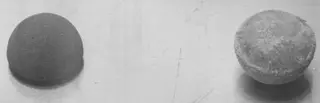
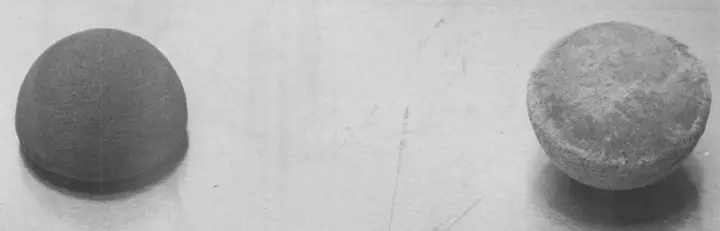
Promethium is a radioactive metal; almost none exists naturally on Earth. It is one of the lanthanides, the row of fifteen “rare earth” metals that are so chemically alike that separating them took chemists most of the 19th century.
Quick answers
- What is promethium?
- Promethium (Pm) is a lanthanide with atomic number 61. It is a solid at room temperature. The only radioactive lanthanide, with no stable isotopes. It was finally identified among the fission products of a nuclear reactor.
- Where is promethium found?
- Only tiny traces form naturally in uranium ores. It is produced in nuclear reactors.
- What is promethium used for?
- Its main uses are nuclear batteries, thickness gauges and luminous paint (historical). Long-lasting batteries for pacemakers and spacecraft once used promethium-147.
At a glance
| Atomic number | 61 |
|---|---|
| Symbol | Pm |
| Mass number (most stable isotope) | [145] |
| Family | Lanthanide |
| Group | f-block (the row below the main table) |
| Period | Period 6 |
| Block | f |
| Electron configuration | [Xe] 4f5 6s2 orbital diagram → |
| State at room temperature | Solid |
| Melting point | 1,042 °C (1,907 °F, 1,315 K) |
| Boiling point | 3,000 °C (5,432 °F, 3,273 K) |
| Density | 7.26 g/cm³ |
| Electronegativity (Pauling) | Not defined or not measured |
| Atomic radius | 236 pm |
| First ionization energy | 5.55 eV |
| Oxidation states | +3 |
| Discovery | 1945 · Jacob Marinsky, Lawrence Glendenin and Charles Coryell |
Discovery
Chemists suspected a missing element between neodymium and samarium from 1902. In 1945 Jacob Marinsky, Lawrence Glendenin and Charles Coryell at Oak Ridge, USA, identified it in uranium fission products.
Where the name comes from
From Prometheus, the Titan who stole fire from the gods and gave it to humanity.
Where is promethium found?
Only tiny traces form naturally in uranium ores. It is produced in nuclear reactors.
Where every element is found →
What is promethium used for?
- Nuclear batteries. Long-lasting batteries for pacemakers and spacecraft once used promethium-147.
- Thickness gauges. Its radiation measures the thickness of thin materials.
- Luminous paint (historical). It replaced radium in some glow-in-the-dark paints.
What every element is used for → · Where are the elements found? →
Notable isotopes
| Isotope | Half-life | Note |
|---|---|---|
| Promethium-145 | about 17.7 years | The longest-lived isotope. |
| Promethium-147 | about 2.6 years | The most commonly used isotope. |
Safety
Radioactive
Promethium is radioactive and handled only in controlled settings.
Did you know?
- In 2024 researchers at Oak Ridge National Laboratory determined the detailed structure of a promethium compound in solution for the first time.
- The Czech chemist Bohuslav Brauner first suggested in 1902 that an element was missing between neodymium and samarium.
Frequently asked questions
Why does promethium have no stable isotopes?
None of its possible combinations of protons and neutrons is stable; the reason lies in the detailed structure of atomic nuclei.
Is promethium a metal?
Yes. Promethium is a metal, one of the lanthanides.
What are the properties of promethium?
Atomic number 61, symbol Pm, atomic mass [145]. It is a solid at room temperature. It melts at 1,042 °C (1,907 °F) and boils at 3,000 °C (5,432 °F). Density 7.26 g/cm³.
Sources
- Royal Society of Chemistry: Promethium
- Encyclopaedia Britannica: Promethium
- USGS Mineral Commodity Summaries: Rare earths
- NNDC NuDat 3 (nuclear data)
- PubChem Periodic Table (NIH)
- IUPAC/CIAAW standard atomic weights
- Royal Society of Chemistry, Periodic Table
- Wikipedia: Promethium
Last checked: 16 November 2026
Other lanthanides
Lanthanum
The metal that gives the lanthanides their name. It is in hybrid-car batteries, camera lenses and the catalysts that refine petrol.
Cerium
The most abundant rare earth element. It polishes glass, cleans car exhaust and makes the sparks in lighters.
Praseodymium
The “green twin” of neodymium. It strengthens magnets, colors glass and ceramics, and protects glassblowers’ eyes.
Neodymium
The rare earth metal behind the strongest permanent magnets, used in electric cars, wind turbines, headphones and phones.
Samarium
The first element named, indirectly, after a person. Samarium–cobalt magnets work at temperatures that defeat other strong magnets.
Europium
The most reactive lanthanide, named after Europe. Its glowing compounds make the reds and blues of screens and LEDs.
Gadolinium
A lanthanide used to sharpen MRI scans. It absorbs neutrons better than any other element and is magnetic around room temperature.
Terbium
A rare earth that glows green in screens and lamps and helps magnets cope with heat. One of four elements named after the same Swedish village.