Element 057
Lanthanum (La)
The metal that gives the lanthanides their name. It is in hybrid-car batteries, camera lenses and the catalysts that refine petrol.
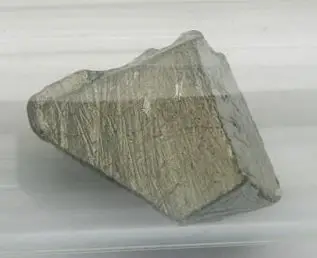
Lanthanum is a soft, silvery-white metal that tarnishes quickly in air. It is one of the lanthanides, the row of fifteen “rare earth” metals that are so chemically alike that separating them took chemists most of the 19th century.
Quick answers
- What is lanthanum?
- Lanthanum (La) is a lanthanide with atomic number 57. It is a solid at room temperature. The metal that gives the lanthanides their name. It is in hybrid-car batteries, camera lenses and the catalysts that refine petrol.
- Where is lanthanum found?
- Lanthanum occurs in monazite and bastnäsite with other rare earths.
- What is lanthanum used for?
- Its main uses are batteries, optical glass and oil refining. Nickel–metal hydride batteries in many hybrid cars use lanthanum-rich alloys.
At a glance
| Atomic number | 57 |
|---|---|
| Symbol | La |
| Standard atomic weight | 138.91 ± 0.01 |
| Natural isotopes | 2 (IUPAC CIAAW 2024) |
| Family | Lanthanide |
| Group | f-block (the row below the main table) |
| Period | Period 6 |
| Block | f |
| Electron configuration | [Xe] 5d1 6s2 orbital diagram → |
| State at room temperature | Solid |
| Melting point | 918 °C (1,684 °F, 1,191 K) |
| Boiling point | 3,464 °C (6,267 °F, 3,737 K) |
| Density | 6.15 g/cm³ |
| Electronegativity (Pauling) | 1.1 |
| Atomic radius | 240 pm |
| First ionization energy | 5.577 eV |
| Oxidation states | +3 |
| Discovery | 1839 · Carl Gustaf Mosander |
Discovery
In 1839 the Swedish chemist Carl Gustaf Mosander found that cerium oxide contained another, hidden oxide: lanthana.
Where the name comes from
From the Greek lanthanein, to lie hidden, because it was concealed in cerium minerals.
Where is lanthanum found?
Lanthanum occurs in monazite and bastnäsite with other rare earths.
Where every element is found →
What is lanthanum used for?
- Batteries. Nickel–metal hydride batteries in many hybrid cars use lanthanum-rich alloys.
- Optical glass. Lanthanum oxide gives camera and telescope lenses a high refractive index.
- Oil refining. Lanthanum catalysts help crack crude oil into petrol.
- Lighter flints. Mischmetal, a rare earth alloy, sparks when struck.
What every element is used for → · Where are the elements found? →
Common compounds
| Compound | Formula | Note |
|---|---|---|
| Lanthanum nickel | LaNi₅ | Hydrogen-storing alloy in nickel–metal hydride batteries. |
Notable isotopes
- La-1380.08881%
- La-13999.91119%
Percent by number of atoms. The light band shows the range over which the share varies in natural samples. Source: IUPAC CIAAW 2024
| Isotope | Half-life | Note |
|---|---|---|
| Lanthanum-139 | Stable | About 99.9% of natural lanthanum. |
| Lanthanum-138 | about 100 billion years | A trace, very weakly radioactive isotope. |
Safety
Low hazard
Lanthanum has low toxicity, but the metal can ignite when finely divided.
Did you know?
- Mosander’s “hidden” element was itself hiding others: didymium was later separated from it, and didymium turned out to be neodymium and praseodymium.
- Lanthanum’s place in the periodic table has long been debated; some tables put lutetium in group 3 instead.
Frequently asked questions
Why are they called lanthanides?
The series is named after lanthanum, the first of the fifteen elements.
Is lanthanum a metal?
Yes. Lanthanum is a metal, one of the lanthanides.
What are the properties of lanthanum?
Atomic number 57, symbol La, atomic mass 138.91. It is a solid at room temperature. It melts at 918 °C (1,684 °F) and boils at 3,464 °C (6,267 °F). Density 6.15 g/cm³. Electronegativity 1.1 (Pauling).
Sources
- Royal Society of Chemistry: Lanthanum
- Encyclopaedia Britannica: Lanthanum
- USGS Mineral Commodity Summaries: Rare earths
- NNDC NuDat 3 (nuclear data)
- PubChem Periodic Table (NIH)
- IUPAC/CIAAW standard atomic weights
- Royal Society of Chemistry, Periodic Table
- Wikipedia: Lanthanum
Last checked: 16 November 2026
Other lanthanides
Cerium
The most abundant rare earth element. It polishes glass, cleans car exhaust and makes the sparks in lighters.
Praseodymium
The “green twin” of neodymium. It strengthens magnets, colors glass and ceramics, and protects glassblowers’ eyes.
Neodymium
The rare earth metal behind the strongest permanent magnets, used in electric cars, wind turbines, headphones and phones.
Promethium
The only radioactive lanthanide, with no stable isotopes. It was finally identified among the fission products of a nuclear reactor.
Samarium
The first element named, indirectly, after a person. Samarium–cobalt magnets work at temperatures that defeat other strong magnets.
Europium
The most reactive lanthanide, named after Europe. Its glowing compounds make the reds and blues of screens and LEDs.
Gadolinium
A lanthanide used to sharpen MRI scans. It absorbs neutrons better than any other element and is magnetic around room temperature.
Terbium
A rare earth that glows green in screens and lamps and helps magnets cope with heat. One of four elements named after the same Swedish village.