Element 026
Iron (Fe)
The main ingredient of Earth’s core and the most used metal. Steel, bridges and machines are made of iron; it also makes blood red.
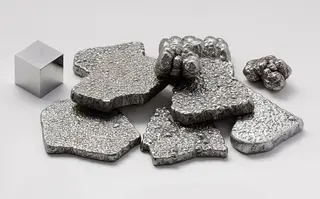
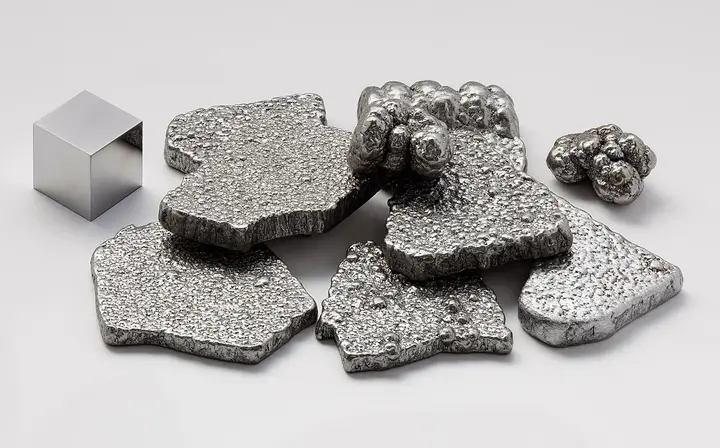
Iron is a shiny, gray transition metal. Pure iron is fairly soft; adding a little carbon turns it into much stronger steel.
In damp air it rusts, forming flaky iron oxide. In the body, iron carries oxygen in hemoglobin, the protein that gives blood its color.
Quick answers
- What is iron?
- Iron (Fe) is a transition metal with atomic number 26. It is a solid at room temperature. The main ingredient of Earth’s core and the most used metal. Steel, bridges and machines are made of iron; it also makes blood red.
- Where is iron found?
- By mass, iron is the most common element on Earth as a whole, because the core is mostly iron and nickel. In the crust it is found in ores such as hematite and magnetite.
- What is iron used for?
- Its main uses are steel; cast iron; magnets and electrical machines. Most iron becomes steel for buildings, bridges, vehicles, tools and appliances.
At a glance
| Atomic number | 26 |
|---|---|
| Symbol | Fe |
| Standard atomic weight | 55.845 ± 0.002 |
| Natural isotopes | 4 (IUPAC CIAAW 2024) |
| Family | Transition metal |
| Group | Group 8 |
| Period | Period 4 |
| Block | d |
| Electron configuration | [Ar] 3d6 4s2 orbital diagram → |
| State at room temperature | Solid |
| Melting point | 1,538 °C (2,800 °F, 1,811 K) |
| Boiling point | 2,861 °C (5,182 °F, 3,134 K) |
| Density | 7.874 g/cm³ |
| Electronegativity (Pauling) | 1.83 |
| Atomic radius | 194 pm |
| First ionization energy | 7.902 eV |
| Oxidation states | +3, +2 |
| Discovery | Known since ancient times |
Discovery
Iron has been known since prehistoric times. The first iron people used came from meteorites, which contain iron–nickel alloy.
Smelting iron from ore spread across the Near East and the Mediterranean around 1200 BCE, the start of the Iron Age there.
Where the name comes from
The English word comes from Old English īren. The symbol Fe comes from the Latin ferrum.
Where is iron found?
By mass, iron is the most common element on Earth as a whole, because the core is mostly iron and nickel. In the crust it is found in ores such as hematite and magnetite.
Where every element is found →
What is iron used for?
- Steel. Most iron becomes steel for buildings, bridges, vehicles, tools and appliances.
- Cast iron. Cookware, pipes and engine blocks.
- Magnets and electrical machines. Iron cores in transformers and motors concentrate magnetic fields.
- Health. Iron supplements treat iron-deficiency anemia, under medical advice.
What every element is used for → · Where are the elements found? →
Common compounds
| Compound | Formula | Note |
|---|---|---|
| Iron(III) oxide | Fe₂O₃ | The ore hematite; also a major part of rust. |
| Iron(II,III) oxide | Fe₃O₄ | Magnetite, the naturally magnetic iron ore. |
| Iron disulfide | FeS₂ | Pyrite, or fool’s gold, named for its brassy yellow shine. |
Notable isotopes
- Fe-545.845%
- Fe-5691.754%
- Fe-572.119%
- Fe-580.282%
Percent by number of atoms. The light band shows the range over which the share varies in natural samples. Source: IUPAC CIAAW 2024
| Isotope | Half-life | Note |
|---|---|---|
| Iron-56 | Stable | About 91.8% of natural iron. Its nucleus is among the most tightly bound of all. |
Safety
Safe metal; too many supplements are dangerous
Iron metal is not toxic. Very fine iron dust can be flammable.
Iron is essential, but an overdose of iron supplements is dangerous, especially for young children. Keep them out of reach.
Did you know?
- Mars looks red because its surface dust contains iron oxide.
- Motion of molten iron in Earth’s liquid outer core generates the planet’s magnetic field.
- The Iron Pillar of Delhi has stood outdoors for about 1,600 years with very little rust.
Frequently asked questions
Why does iron rust?
Iron reacts with oxygen and water to form hydrated iron oxides, which flake off and expose fresh metal.
What is the difference between iron and steel?
Steel is iron with a small amount of carbon (and often other metals), which makes it much stronger and harder.
Is iron a metal?
Yes. Iron is a metal, one of the transition metals.
What are the properties of iron?
Atomic number 26, symbol Fe, atomic mass 55.845. It is a solid at room temperature. It melts at 1,538 °C (2,800 °F) and boils at 2,861 °C (5,182 °F). Density 7.874 g/cm³. Electronegativity 1.83 (Pauling).
Sources
- Royal Society of Chemistry: Iron
- Encyclopaedia Britannica: Iron
- NNDC NuDat 3 (nuclear data)
- PubChem Periodic Table (NIH)
- IUPAC/CIAAW standard atomic weights
- Royal Society of Chemistry, Periodic Table
- Wikipedia: Iron
Last checked: 16 November 2026
Other group 8 elements
Ruthenium
A hard, rare platinum-group metal used in hard drives, electronics and Nobel Prize-winning catalysts.
Osmium
The densest naturally occurring element, narrowly ahead of iridium. A football-sized ball of osmium would weigh about as much as two adults.
Hassium
A superheavy element named after the German state of Hesse. One of the few superheavy elements whose chemistry has been studied.